
The collection of documents and films date to World War II when Lindbergh worked with Mayo to research the effects of high-altitude flight on humans. The work was well documented, but done in secret for the U.S. government.
The research helped keep wartime pilots alive at altitudes reaching an unprecedented 40,000 feet. It also established the first procedures for surviving parachute jumps from such height.
Dr. Jan Stepanek, an aviation medicine specialist, reviewed more than 70 hours of color film along with thousands of documents and photographs to prepare the material for its initial public display unveiled this week.
Although Stepanek said pieces of the research had been available publicly for many years, the display is the first time it has been presented comprehensively with an emphasis on Lindbergh's role.
Erik Lindbergh, grandson of the pilot, said he was astounded to learn about his family's history with Mayo.
"What happened here at the Mayo Clinic - not only with my grandfather but with everything that was done - it's extraordinary," he said. "I had no idea how extensive this was or what it entailed."
Stepanek said the high-altitude research conducted by Mayo helped develop and refine an in-flight oxygen tank, a parachute tank and flight suits. ``A lot of very basic aviation science that holds true to this day was done in Rochester,'' he said. ``These are things that were imperative to us winning the war.''
Stepanek said he plans to assemble the story of Mayo's once-classified research into a book.
ROCHESTER, Minn. (October 9, 2002)—Associated Press— Mayo Clinic has unveiled a collection of once-classified government research that details work done with trans- Atlantic pilot Charles Lindbergh.
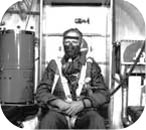
Charles Lindbergh worked with Mayo researchers in 1942 to develop anti-blackout technology for pilots.
(Mayo Clinic Photo)

Privacy Policy | Terms and Conditions | This site is not affiliated with the Lindbergh family,
Lindbergh Foundation, or any other organization or group.
This site owned and operated by the Spirit of St. Louis 2 Project.
Email: webmaster@charleslindbergh.com
® Copyright 2014 CharlesLindbergh.com®, All rights reserved.
Help support this site, order your www.Amazon.com materials through this link.
